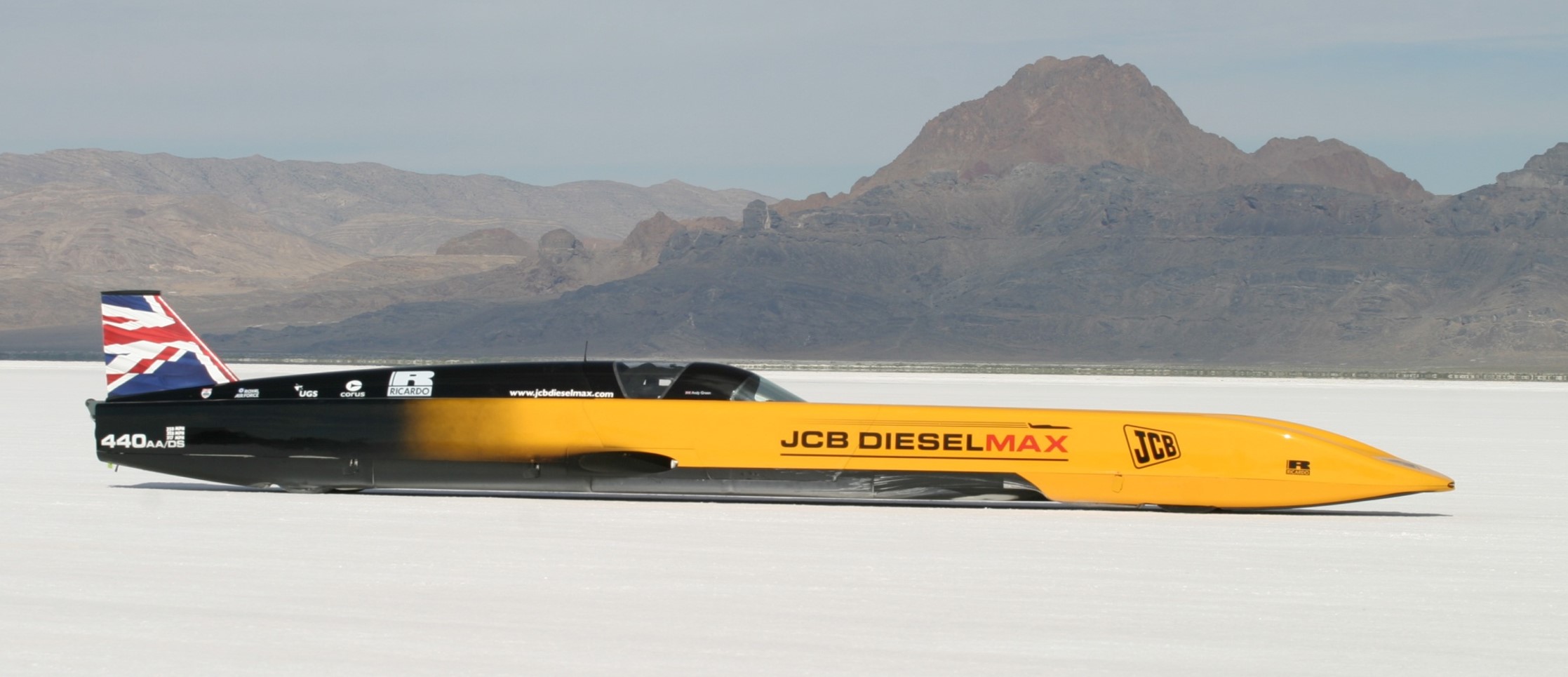
Pushing the boundaries of innovation is essential for the future of the industry. It is the innovation, ambition, and determination of the teams behind these projects that drive progress, challenge expectations, and demonstrate what is possible. Reflecting on how these boundaries have been pushed throughout history is equally important, as it allows us to recognise the achievements that have shaped the present, learn from the challenges overcome along the way, and inspire the next generation of engineers to continue innovating and advancing what is possible.
Celebrating the 20th anniversary of the JCB DieselMax, we reflect on an important chapter of Envisage (formerly Visioneering) history. While engineering and technology have changed considerably over the last two decades, it was this opportunity to solve an extraordinary engineering challenge that helped shape Envisage and the values that continue to influence the business today.
A Historic Collaboration
DieselMax was a project that brought together some of the industry’s leading engineering expertise, with considerable ambition, challenging timescales, and highly complex engineering problems. Every element had to work together seamlessly to deliver a vehicle capable of performing at exceptionally high speeds. Being a part of this project was an opportunity to put our expertise to the test, collaborating across multiple teams, contributing their own knowledge and experience to a shared goal. Achievements such as the DieselMax are built through the exchange of ideas; asking questions, challenging assumptions, and generating solutions through these partnerships.
Our Contribution
We were responsible for the mechanical design and construction of the vehicle. This included the chassis and bodyshell, a unique braking system, the suspension and steering, and all associated vehicle systems, cooling, lubrication, electronic control, data logging and engine & transmission installations. The vehicle weighed four times as much as a Formula 1 car and travelled at twice the speed, therefore we had to manufacture a braking system capable of absorbing far more energy. To achieve this, we fitted the largest brakes that could be accommodated inside the 15-inch wheels. With the DieselMax being unlike any vehicle the team had worked on before, the project presented a unique opportunity to innovate. Following the completion of our work in less than 10 months, the car was transported to Utah, USA.
The experience gained through projects such as DieselMax forms part of the knowledge and heritage that Envisage carries forward. The lessons learned from working on ambitious, technically demanding programmes continue to influence how our teams approach challenges today. A fundamental ambition remains: to support our clients with their manufacturing and production processes through innovating, solving complex problems, and leveraging our cross-sector learnings.
Breaking the Record
JCB DieselMax is 30 feet long and 45 inches wide, weighs 2700 kg, and is powered by two turbocharged JCB444 engines. These normally generate a maximum of 140 bhp and are used in JCB backhoe diggers and Load-all telescopic handlers. Development work from the consulting engineers, based in Shoreham, boosted their individual outputs to 750 bhp. In seven days on the Bonneville Salt Flats three new records were set. The first on August 18, the Southern California Timing Association – Bonneville Nationals Inc (SCTA-BNI) National Record, raising it from 306.8 mph to 317.021 mph. Then on August 22, the 33-year-old Federation Internationale de l’Automobile (FIA) record raising it from 235.756 mph to 328.767 mph. Finally, on August 23, the JCB DieselMax broke its own record for the FIA, achieving 350.092 mph. This made the vehicle the world’s fastest diesel-powered vehicle and 20 years later, the record is still unbeaten.
A Legacy that Continues
Projects like DieselMax provide a connection between generations of engineers, demonstrating the capabilities of our experts, while offering inspiration to those working on the challenges of today and tomorrow. The lessons are not necessarily about recreating the past but being a part of the foundation on which the future is built and understanding the qualities that made those achievements possible in the first place: curiosity, determination, collaboration, a willingness to challenge convention, and the confidence to take on problems that initially seem impossible. These qualities remain as important to Envisage today as they were 20 years ago.